
Why This Keeps Coming Up
The Golden Rule has been around forever:
“Treat others the way you want to be treated.”
It’s a noble principle, and one worth living by. But recently, this idea has been popping up in various ways—in a movie scene, even in a conversation with my parents.
When themes continue to surface like that, I tend to lean in—it sticks with me. (Maybe I overthink it. Either way—it matters.)
The Catch: We’re Not All the Same
I’m not one to argue with a screenwriter or my parents (well…). But here’s something my work and life experiences have taught me—something that builds on the Golden Rule:
We are not all wired the same.
What feels respectful to one person might land very differently with someone else—dismissive, irrelevant, or even offensive. If we treat others only based on how we want to be treated, we risk misfires—sometimes subtle, sometimes damaging or alienating.
Taken too literally, the Golden Rule can even give some people (the rude or abrasive) unintentional permission to justify treating others poorly, because they would accept the same behavior. In short—on its own, it doesn’t fully account for the uniqueness of every person.
Enter the Platinum Rule
That’s where The Platinum Rule builds on it with something just as powerful—but often forgotten:
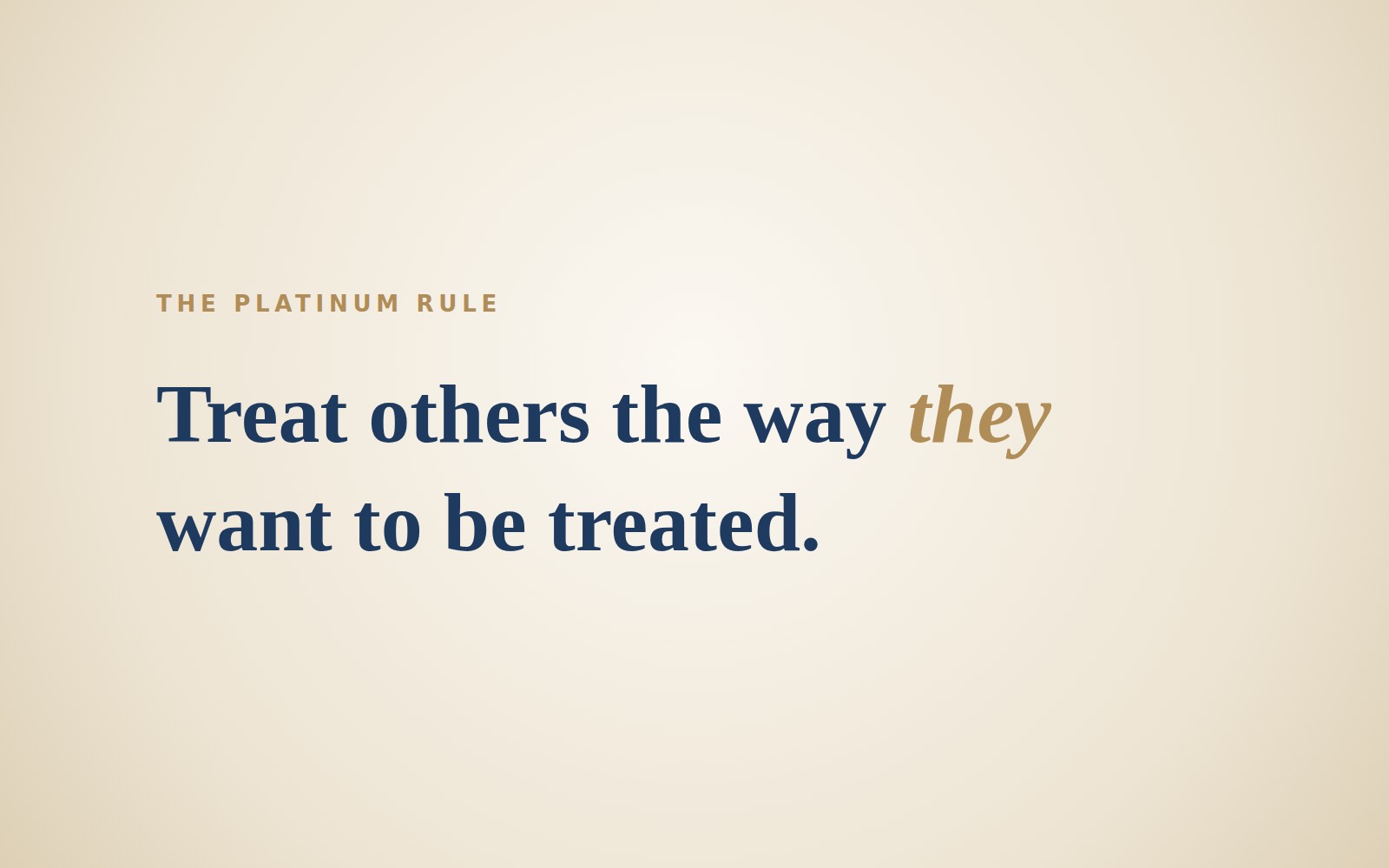
“Treat others the way they want to be treated.”
This small but meaningful shift invites us into empathy and self-awareness—two skills vital to effective leadership, healthy communication, and meaningful relationships.
If we want to connect meaningfully—whether it’s with a team member, a client, a significant other, or a friend—understanding how they feel respected, heard, and valued is essential.
This doesn’t mean abandoning your own values or perspective—it means expanding them by making space for others’—and for how they feel respected, heard, and valued.
Why This Matters in Leadership
I’ve seen this play out across organizations and coaching relationships around the world. Two leaders can have the same goals—but wildly different impacts—depending on how well they understand and adapt to what others need (or sometimes, simply want).
Picture two team members receiving the same feedback. One wants it direct and fast—just tell me what to fix. The other needs context first, and a private conversation, or they’ll shut down. A leader running only on the Golden Rule delivers it to both the way the leader would want to hear it. A leader practicing the Platinum Rule asks how each person needs to hear it.
The same is true for recognition (a public shout-out energizes some people and mortifies others), communication (some people think out loud in the meeting; others need the question in writing the night before), and support (for one person it’s a solution; for another it’s simply being heard).
Empathy isn’t soft. It’s strategic.
That understanding begins with curiosity, continues with listening, and is powered by a willingness to lead with humility.
Self-awareness isn’t just about knowing your triggers—it’s about understanding how you affect others.
A few questions worth asking the people you lead:
- How do you prefer to receive feedback?
- What kind of recognition actually means something to you?
- When things get stressful, what helps most from me?
Final Thought (And a Gentle Nudge)
The Golden Rule isn’t wrong—it’s a great foundation. The Platinum Rule simply builds on it.
The Platinum Rule asks more of us—not just as leaders, but as people. It pushes us to create stronger connections by listening more deeply, assuming less, leading with intention, and sending out energy others want to be around.
If all that sounds like something you’re not interested in… well, you probably stopped reading a while ago. 😉